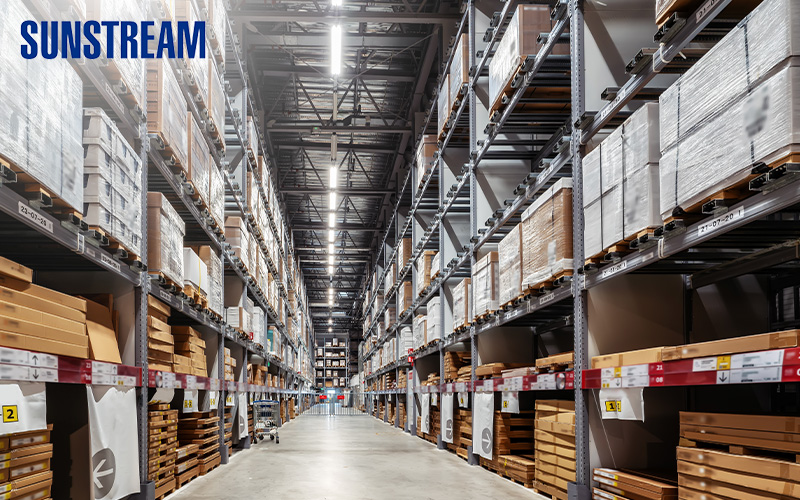
Delayed shipments, damaged goods, rising material costs, and tightening environmental regulations have become recurring challenges for businesses operating across borders. Products now travel longer distances, pass through more handling points, and face greater variability in transport and storage conditions. When packaging fails to perform under these pressures, the result is often increased waste, higher costs, and disrupted operations.
These challenges highlight why packaging can no longer be treated as a static or secondary consideration. In today’s environment, packaging plays a direct role in protecting product integrity, maintaining logistics efficiency, and supporting compliance across multiple markets. As organisations respond to global chain supply challenges, packaging systems must be able to adapt to uncertainty rather than react to it.
In the upcoming sections of this guide, we’ll examine how businesses can prepare their packaging systems to better manage global chain supply challenges. We’ll explore the key pressures affecting packaging across international supply chains and how these challenges impact operational efficiency, costs, and customer confidence.
Key Takeaways
|
By the end of this article, you’ll have a clearer understanding of how strategic packaging decisions can help reduce risk, improve efficiency, and support long-term supply chain resilience.
What Are the Biggest Packaging Challenges in Global Supply Chains?

Packaging must perform reliably across a wide range of operational conditions, yet global supply chains are becoming more fragmented and unpredictable. Extended transit routes, frequent handling, and shifting logistics pathways expose packaging systems to stresses that were not always considered during initial design.
As supply networks become more complex, businesses face global chain supply challenges that test the limits of conventional packaging approaches.
1. Supply Chain Disruptions and Transit Uncertainty
Unpredictable shipping schedules, port congestion, and rerouted freight increase transit duration and handling frequency. Packaging designed for stable timelines may not perform adequately when goods remain in circulation longer than expected. Extended exposure to vibration, compression, and environmental stress increases the likelihood of packaging failure, particularly for products with tight tolerance requirements.
2. Product Damage During Transit
Long-distance shipping exposes goods to repeated mechanical stress. Transfers between sea, air, and land transport introduce varying handling standards, often outside a company’s direct control. Without sufficient structural reinforcement or internal protection, packaging may fail to absorb impact forces. Losses from transit damage are especially costly when compounded by ongoing global chain supply challenges that already strain inventory availability and fulfilment timelines.
3. Regulatory Compliance Across Markets
Packaging must meet diverse environmental and safety regulations across different regions. Recycling standards, material restrictions, and labelling requirements vary widely and continue to evolve. Ensuring compliance while maintaining performance can be challenging, particularly when packaging changes must be implemented quickly in response to regulatory updates or market entry requirements.
4. Rising Material Costs and Availability Constraints
Volatility in raw material supply affects both cost predictability and material selection. Businesses may be forced to substitute materials due to shortages or price increases, sometimes without sufficient time for testing or optimisation. These rapid adjustments can compromise packaging performance and consistency if not carefully managed.
5. Demand Volatility and Packaging Inefficiency
Fluctuating order volumes and product variations place pressure on fixed packaging formats. Overpacking increases material use and shipping costs, while underpacking raises the risk of damage. In the context of global chain supply challenges, inefficient packaging magnifies operational inefficiencies and reduces responsiveness.
Together, these challenges highlight the need for packaging systems that are resilient, adaptable, and capable of maintaining performance under variable conditions.
How Do These Challenges Impact Businesses and Consumers?
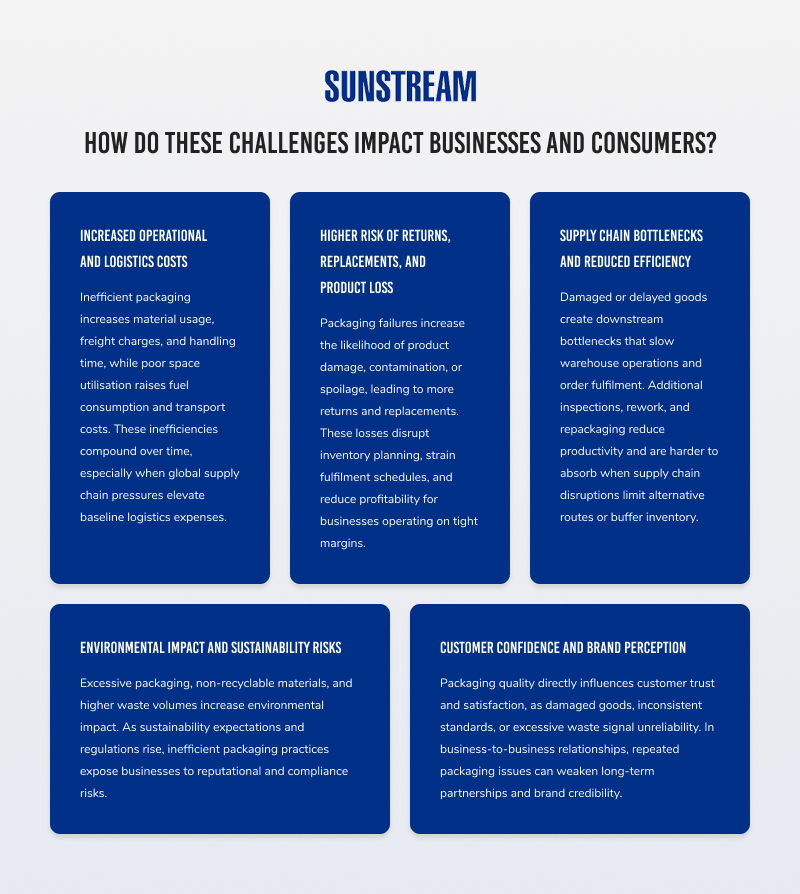
When these packaging challenges are not addressed effectively, their impact extends far beyond damaged cartons or delayed shipments. The consequences are felt across operations, customer relationships, and long-term business performance. As organisations contend with global chain supply challenges, weaknesses in packaging systems often amplify disruption rather than contain it.
1. Increased Operational and Logistics Costs
Inefficient packaging leads to higher material consumption, increased freight charges, and longer handling times. Poorly optimised packaging can result in wasted space during transport, higher fuel usage, and reduced container utilisation. Over time, these inefficiencies compound, particularly when global chain supply challenges drive up baseline logistics costs and limit opportunities for rapid correction.
2. Higher Risk of Returns, Replacements, and Product Loss
Packaging failures increase the likelihood of product damage, contamination, or spoilage. Returns and replacements not only raise direct costs but also disrupt inventory planning and fulfilment schedules. For businesses operating under tight margins, repeated losses reduce profitability and place additional strain on already pressured supply chains.
3. Supply Chain Bottlenecks and Reduced Efficiency
Damaged or delayed goods create downstream bottlenecks, slowing warehouse operations and order fulfilment. Manual rework, inspections, and repackaging further reduce productivity. These disruptions are harder to absorb when global chain supply challenges limit access to alternative transport routes or buffer inventory.
4. Environmental Impact and Sustainability Risks
Excessive packaging, non-recyclable materials, and increased waste contribute to a larger environmental footprint. As sustainability expectations rise, inefficient packaging practices expose businesses to reputational risk and regulatory scrutiny. Addressing these issues becomes more complex when packaging decisions must be made quickly in response to global chain supply challenges.
5. Customer Confidence and Brand Perception
For customers, packaging quality is a tangible indicator of reliability. Damaged goods, inconsistent packaging standards, or excessive waste undermine trust and satisfaction. In business to business environments, where long-term partnerships are built on consistency and performance, repeated packaging issues can weaken confidence and influence supplier selection decisions.
Ultimately, the impact of packaging challenges is cumulative. Without resilient and adaptable packaging strategies, businesses face higher costs, reduced efficiency, and erosion of customer trust, outcomes that are increasingly difficult to manage in the face of global chain supply challenges.
What Materials and Design Innovations Can Improve Packaging Resilience?

Addressing the operational and customer impacts requires a shift from reactive packaging fixes to deliberate, resilient design. As businesses adapt to ongoing supply challenges, material selection and packaging design become critical tools for reducing risk, improving efficiency, and maintaining consistency across complex logistics networks.
1. Durable, Lightweight Materials
Modern packaging materials are increasingly engineered to deliver strength without excessive weight. Lightweight yet durable materials reduce shipping costs while maintaining protection during extended transit and repeated handling. This balance is particularly important when global chain supply challenges lead to longer routes, additional transfers, or limited transport availability.
2. Modular and Adaptable Packaging Designs
Rigid, single-use packaging formats limit flexibility when demand patterns change. Modular designs allow packaging to accommodate multiple product sizes or configurations using standardised components. This adaptability reduces material waste, simplifies inventory management, and enables faster response when product volumes fluctuate due to global chain supply challenges.
3. Protective Engineering for Transit Stress
Packaging must be designed to absorb vibration, compression, and impact throughout the supply chain. Engineered inserts and protective layers, including paper cushioning and box cushioning, help stabilise products, absorb shock, and reduce movement within cartons while supporting recyclability and material efficiency. These protective measures reduce damage rates and minimise the need for costly replacements or rework.
4. Eco-Conscious Materials with Performance Integrity
Sustainable packaging is no longer optional, but environmental responsibility must not compromise protection. Advances in recyclable and renewable materials have improved durability and consistency, making them suitable for long-distance transport. Selecting eco-conscious options that meet performance requirements supports compliance while aligning with sustainability goals in the context of global chain supply challenges.
5. Optimised Structural Layouts and Space Efficiency
Efficient packaging design considers how products are arranged within cartons and how cartons are stacked during transport. Optimised layouts reduce void space, improve pallet stability, and lower overall transport volume. These efficiencies help control costs and reduce emissions, particularly when logistics networks are strained by global chain supply challenges.
By combining resilient materials with adaptable, performance-driven design, businesses can build packaging systems that not only protect products but also strengthen supply chain reliability under uncertain conditions.
How Can Technology and Automation Strengthen Packaging?
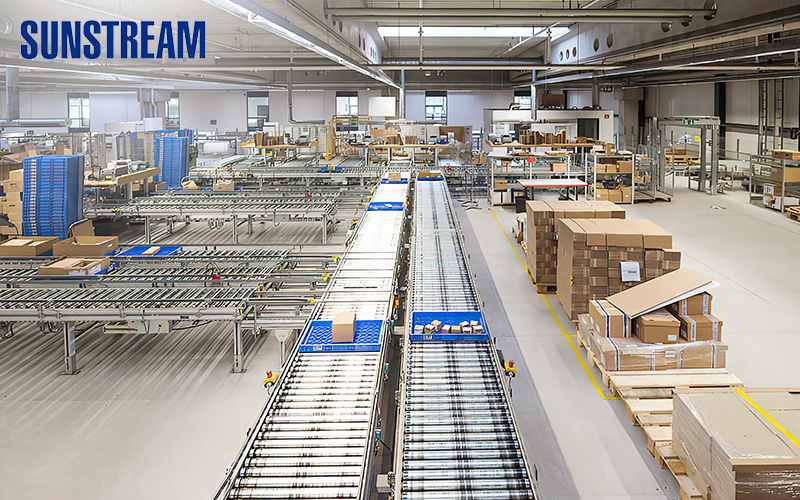
While resilient materials and intelligent design form the foundation of future-proof packaging, technology and automation provide the operational control needed to sustain performance at scale. As supply chains grow more complex, digital tools help businesses move from reactive problem-solving to proactive management, especially when navigating global chain supply challenges.
1. Automated Packing Systems
Automated packaging systems standardise packaging processes, ensuring consistent pack quality regardless of volume fluctuations. By reducing manual intervention, automation minimises errors such as underpacking or excessive material use. This consistency becomes especially important when global chain supply challenges introduce unpredictable order patterns and compressed fulfilment timelines.
2. AI and Data Analytics
AI-powered analytics allow businesses to monitor packaging performance and material consumption in real time. These systems identify inefficiencies, forecast demand shifts, and highlight potential bottlenecks before they disrupt operations. Data-driven insights enable packaging strategies to evolve proactively rather than reactively, a critical advantage during periods shaped by global chain supply challenges.
3. Smart Sensors and IoT Monitoring
IoT-enabled sensors provide visibility into handling conditions throughout transit. Monitoring factors such as temperature, humidity, and shock exposure helps organisations understand where and how packaging is stressed. This information supports targeted design improvements and better handling protocols, reducing damage rates and improving reliability across complex logistics networks.
4. Systems Integration and Predictive Maintenance
When packaging operations are integrated with warehouse management and logistics platforms, coordination improves across the supply chain. Predictive maintenance tools further enhance reliability by identifying equipment issues before failures occur. Minimising downtime and unplanned disruptions helps maintain throughput and consistency, even when global chain supply challenges place additional pressure on operations.
Together, these technologies strengthen packaging systems by improving control, visibility, and adaptability. By combining automation with data-driven insights, businesses can maintain efficiency, reduce waste, and protect product integrity in an increasingly uncertain supply chain environment.
Frequently Asked Questions
1. How can small businesses implement future-proof packaging without large upfront costs?
Small businesses can start with modular or semi-automated systems that improve efficiency without heavy investment. Introducing process improvements such as standardised pallet wrapping can enhance load stability and reduce handling-related damage, while leasing equipment or scaling gradually as demand grows helps businesses adopt future-proof strategies cost-effectively.
2. Are eco-friendly materials reliable for long-distance shipping?
Yes. Modern sustainable materials are designed to be durable and protective. Combining them with protective inserts or reinforced designs ensures products remain safe during transit while reducing environmental impact.
3. How does automation help reduce packaging risk and waste?
Automated packing machines ensure consistent packaging, minimise human errors, and optimise material usage. This not only reduces product damage but also lowers material waste, increases speed, and improves overall supply chain efficiency.
Conclusion
As global supply chains continue to evolve, packaging has emerged as a critical lever for resilience, efficiency, and risk management. Disruptions, regulatory complexity, material volatility, and shifting demand patterns have made it clear that traditional, static packaging approaches are no longer sufficient. Without thoughtful design and strategic planning, packaging can quickly become a point of failure rather than a source of stability.
Future-proof packaging addresses global chain supply challenges by prioritising durability, adaptability, and operational consistency. The use of resilient materials and modular designs helps protect products across longer and more complex logistics routes, while reducing waste and inefficiency. At the same time, automation and data-driven technologies provide the visibility and control needed to maintain performance, even as conditions change. Together, these strategies enable businesses to respond proactively rather than reactively to disruption.
If your organisation is reviewing how its packaging systems can better support operational resilience, Sunstream Industries works with businesses to develop practical, performance-driven packaging solutions. Contact Sunstream Industries today to explore how thoughtful packaging design, materials, and automation strategies can strengthen your supply chain and prepare it for the challenges ahead.
January 28, 2026




 Sunstream Industries